Quick Answer: A lot of moving-day frustration starts with unclear box labels, which can lead to misplaced boxes, slower unloading, and harder unpacking. The most effective approach is a simple system that combines room names, color coding, box numbers, and a basic inventory list so boxes are easy to place and easy to find later.
Why Labeling Moving Boxes Matters More Than You Think
Labeling is not just about staying organized while packing. It also affects how smoothly the move goes and how quickly you can get settled.
Boxes marked “misc” or “kitchen stuff” tend to slow things down during unloading. Without clear placement instructions, movers may need to stop, ask questions, or make their best guess about where a box belongs. That can lead to delays and boxes ending up in the wrong room.
A clear labeling system removes that friction. It gives immediate direction during unloading and makes unpacking much more straightforward.
- Faster unloading with fewer interruptions
- Fewer misplaced or hard-to-find boxes
- Easier unpacking with clearer priorities
- Less back-and-forth on moving day
For a broader timeline of how labeling fits into your move, see this complete moving checklist.
The Best Moving Box Labeling System (Step-by-Step)
The most reliable approach is not a single trick. It is a system that works during packing, loading, unloading, and unpacking.
A common mistake is relying on just one method, usually writing only the room name. That can work for a small number of boxes, but it becomes harder to manage as the move gets larger. A layered system keeps everything consistent and easier to follow.
Step 1: Label by Room (Not Just Contents)
Start with the destination room. “Kitchen” or “Bedroom 2” is more useful than listing items alone.
When labels focus only on contents, movers do not have clear placement instructions. That can lead to delays and misplaced boxes during unloading.
Step 2: Use a Color-Coding System
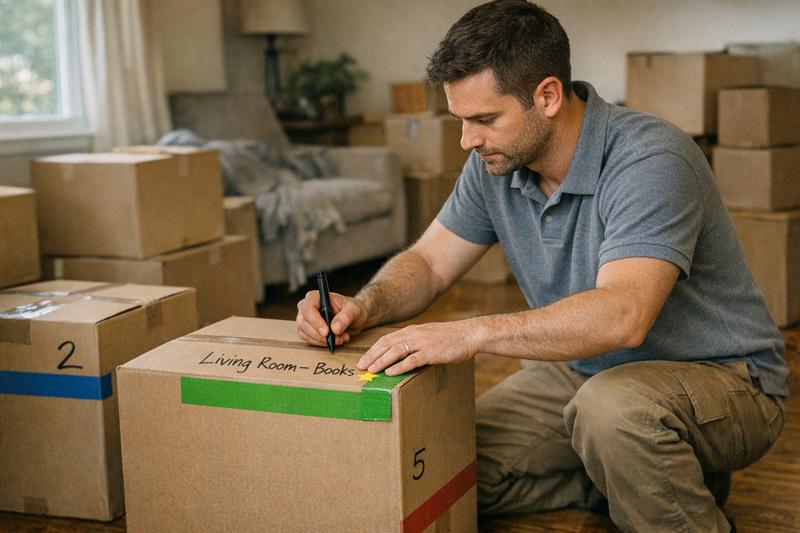
Assign a color to each room and place that color on multiple sides of every box.
This helps movers sort boxes quickly without reading every label. In larger homes or multi-room moves, it can cut down on decision time during unloading.
Step 3: Add a Box Numbering System
Number each box within its room, such as Kitchen #1 or Kitchen #2.
This makes tracking easier. If something is delayed or hard to find, you can identify what is missing without guessing.
Step 4: Create a Simple Inventory List
Match each box number with a short description of the contents.
This does not need to be detailed. The goal is to avoid opening several boxes just to find one item. A simple system like this moving inventory checklist can help keep everything traceable.
Step 5: Mark Priority and Essentials Boxes
Clearly label the boxes you will need first, such as “Open First” or “Essentials.”
This helps prevent important items from getting buried under non-urgent boxes and makes the first day in your new space easier to manage.
What Information Should Be Written on Every Box
Each box should be readable in seconds. If a label takes too long to interpret, it slows down the move.
- Room name in large, visible text
- Short description of contents
- Handling notes such as fragile or heavy
- Box number for tracking
Over-labeling is a common mistake. When too much information is added, labels become harder to scan quickly. In most cases, clear and minimal works better.
Common Mistakes That Slow Down Unpacking
Unpacking delays usually trace back to decisions made during packing.
Over-Labeling vs Under-Labeling
Too little detail creates confusion. Too much detail creates clutter. The best balance is room-based labeling with a short description.
When that balance is missing, unpacking often turns into opening boxes just to figure out what is inside.
Writing Only on the Top of Boxes
Boxes are stacked in trucks and inside the home, so top labels are often hidden.
That leads to extra handling because boxes need to be turned or moved just to read them.
Not Coordinating With Movers
Labels that only make sense to you can slow everything down.
If movers need to pause and ask where items go, the workflow becomes less efficient and unloading takes longer.
Skipping an Inventory System
Without numbering or tracking, it is harder to confirm that everything arrived.
Small issues can also take longer to catch. A missing box may not be noticed until later, and locating it becomes more time-consuming.
Labeling Tips for Different Types of Moves
Residential Moves
Focus on room-based labeling and clearly marked essentials. Most households benefit from having immediate access to daily-use items.
Apartment or Multi-Floor Moves
Add floor numbers, unit details, and any useful access notes.
In buildings with elevators or move-in restrictions, unclear labeling can slow down entry and placement. For more planning details, review this apartment moving checklist.
Commercial or Office Moves
Use department-based labeling and clearly identify equipment.
In office moves, organization directly affects how quickly the space can be set up again. Poor labeling can delay that process and create avoidable disruption.
How Professional Movers Use Labels During a Move
Movers rely on clear, consistent signals to work efficiently. Straightforward labels are easier to use during a fast-paced move than labels that are cluttered or inconsistent.
How Crews Sort and Stage Boxes
Boxes are typically grouped by room and staged for efficient unloading.
Color coding and large labels help crews move quickly without needing to verify every box one by one.
Why Clear Labeling Reduces Move Time
Clear labeling helps keep the process moving. It reduces questions, improves placement accuracy, and keeps unloading more organized.
That is why structured labeling is useful whether you are packing yourself or working with professional movers. When labels are consistent, the move tends to run with fewer interruptions.
If your labeling system is unclear, the problems usually show up quickly:
- Movers repeatedly ask where boxes belong
- Boxes are placed in the wrong rooms
- Unpacking takes longer than expected
- Important items are harder to locate
If you notice these issues while packing, it is usually a sign that the system should be adjusted before moving day.
Tools and Supplies That Make Labeling Easier
Essential Supplies
Use thick markers, color labels or tape, and simple stickers to keep labeling consistent.
If you are still getting ready, this packing supplies list covers what is typically needed.
Digital vs Paper Inventory Systems
Both options can work well if you use them consistently. A notebook is quick and simple. A spreadsheet makes searching easier.
The method matters less than consistency. If the list is not updated as you pack, it quickly becomes less useful.
Conclusion
The main reason unpacking feels slow and frustrating is often not the number of boxes. It is how those boxes are labeled.
When labeling is unclear, boxes are more likely to be misplaced, time gets wasted, and unpacking becomes more drawn out than it needs to be. That tends to become more noticeable as moves get larger or more complex.
A structured labeling system helps prevent those problems before they start. It gives movers clear direction, keeps boxes easier to track, and lets you unpack with purpose instead of guesswork.
Quantum Moving uses these practical systems every day for residential and commercial moves in the Bay Area. The goal is simple: reduce confusion, keep the process efficient, and help make sure everything ends up where it belongs.
If you want your move to stay organized from start to finish, the next step is to set up this system before packing continues or work with a team that already uses one.
Key Takeaways
- Label by room first, not by detailed contents alone
- Use color coding, numbering, and inventory together
- Write labels on multiple sides of every box
- Mark priority boxes clearly
- Think about how movers will use your labels
FAQ
What is the best way to label moving boxes?
The best approach is to combine room labels, color coding, box numbers, and a simple inventory list. This keeps boxes organized during both the move and unpacking. Setting it up before packing begins usually makes the process easier to manage.
Should you label the top or side of moving boxes?
It is best to label multiple sides of the box. Boxes are stacked during transport, so side labels are more likely to stay visible and help guide placement into the correct room.
How do you label fragile items when moving?
Mark “Fragile” clearly on multiple sides and add notes such as “This Side Up” when needed. Clear labeling helps communicate handling needs, especially when paired with careful packing.
Is color coding moving boxes worth it?
Yes, color coding can speed up sorting and placement. Movers can identify where boxes belong more quickly without reading every label, which is especially helpful in larger moves.
How detailed should moving box labels be?
Labels should stay simple, with room names and short descriptions. Too much detail can slow down packing and is not especially helpful during unloading. A separate inventory list is better for more detailed tracking.
Do professional movers rely on box labels?
Yes, clear labels help movers work more efficiently and place boxes more accurately. Labels guide how boxes are grouped and where they are delivered, which helps keep the move organized.